I made my first $50 on Upwork three years ago after sending 22 proposals over six weeks. By the end of year one I'd hit Top Rated status and was billing $45/hr. By year two my rate was $80/hr and I'd stopped bidding on jobs entirely — clients invited me directly.
Most of what I read about Upwork advice is written by people who've never actually used it for QA work. Generic "send personalized proposals" advice doesn't help when you're competing against 30 other QA freelancers, half of whom have 50+ five-star reviews and you have zero. This post is the playbook I actually used, including the bits that feel uncomfortable but work.
Table of Contents
- The actual numbers (15-40 proposals isn't an exaggeration)
- What clients skip past in 3 seconds
- Your profile: the part most people get wrong
- The niche-down strategy that actually works
- The proposal template that landed my first 3 clients
- Picking the right first jobs (it's not the highest-paying)
- Pricing: how to position $0 to $40/hour
- After the first client: how to compound
- FAQs
The Actual Numbers (15-40 Proposals Isn't an Exaggeration)
I tracked every QA automation job I bid on for two months. Out of 47 jobs:
- Average proposals at the moment I submitted: 23
- Average proposals by the time the job closed: 34
- Range: 8 (lowball $5/hr listings) to 67 (well-paid $50/hr listings)
- Jobs I got interviewed for: 6 (12.7%)
- Jobs I got hired for: 3 (6.4%)
That's the conversion rate to plan around. If you send 50 proposals, expect 3 interviews and 1 hire. The hire happens when you do everything right; the interviews happen when you do most things right. The 47 misses are normal, not a sign you're failing.
What Clients Skip Past in 3 Seconds
Hiring managers on Upwork get 30 proposals on a busy job. They have maybe 10 minutes to triage. They skim, not read. Three patterns get you skipped:
- Generic openers. "I am writing to apply for the position you have posted." Anyone using this never even gets to the second paragraph.
- Profile photo issues. No photo, blurry photo, group photo, photo with sunglasses, AI-generated photo. All read as "not serious." A clean head-and-shoulders shot taken on a phone is enough.
- The 0% job success score. First-time freelancers can't avoid this — Upwork shows your job success score (JSS) once you have feedback. New profiles get a discount in the algorithm but compete against established freelancers. The way through is volume early, then quality.
Hiring managers see your photo, name, top-line skill, hourly rate, and the first sentence of your proposal. That's it before they decide to keep reading or move on. Optimize that bundle.
Your Profile: The Part Most People Get Wrong
Two profile mistakes that kill new freelancers:
Mistake 1: Listing every skill
"QA Automation, Selenium, Cypress, Playwright, JMeter, Postman, Appium, JIRA, TestRail, Jenkins, Docker, Kubernetes, AWS, Azure, GCP, MySQL, PostgreSQL..."
This signals "junior trying to look senior." Senior freelancers list 4–6 skills and are deep on each. Pick a hero skill (one of Playwright, Cypress, or Selenium), an API testing skill, a CI/CD skill, and one or two domain modifiers ("e-commerce QA" or "fintech QA"). Stop there.
Mistake 2: Generic title
"QA Engineer" — competing with 50,000 others. "Playwright Automation Engineer | E-commerce Specialist" — competing with maybe 200. The narrower title gets fewer searches but ranks much higher in those searches, and clients who find you are pre-qualified.
Mistake 3: Bio reads like a resume
Resume bullets list responsibilities. Upwork bios should answer "why hire me for this?" Read your bio aloud — if it sounds like a job description for the role you've held, rewrite it.
Better template:
"I help [type of company] [achieve specific outcome] using [primary tool]. In the last [time], I've [specific result or proof point]. If you need [common pain point], here's how I'd approach it: [2 sentences]. Below are 3 of my recent projects."
Specific, outcome-focused, ends with proof. The hiring manager finishes your bio and already trusts that you've solved a problem like theirs.
The Niche-Down Strategy That Actually Works
"Niche down" is generic advice. Here's the version that actually works for QA freelancers:
Pick a tool + an industry + a deliverable.
- Tool: Playwright
- Industry: SaaS startups
- Deliverable: "set up your first automated test suite from scratch"
That's a real niche. The market is big enough that hundreds of jobs match. The competition is small enough that you can win. And the deliverable is clear enough that clients know exactly what they're buying.
Compare to: "QA engineer with experience in many tools and industries." Nothing to grab onto.
The compounding effect: once you have three projects in this niche, your portfolio reads as specialist, your reviews mention specifics, and clients in that niche find you organically. Your second year on Upwork is way easier than your first if your first year was niche-focused.
The Proposal Template That Landed My First 3 Clients
Total length: under 150 words. Reads in 30 seconds.
Hi [client name if visible],
You mentioned [specific thing from the job post — a tool, a problem, a goal]. I had this exact issue last month on a [similar project type], and the fix was [one-sentence summary of approach].
Quick context on me: I'm a [niche] specialist. Recent project: [link to portfolio piece or anonymized case study]. Result: [specific number — "cut their CI from 22 minutes to 6" or "caught 14 production bugs pre-release in the first month"].
For your project, I'd start with [first specific action]. We'd know within [time] whether [the approach is working]. Happy to walk through the plan on a 15-minute call this week.
Tayyab
Why this works:
- First sentence proves you read the post.
- Second sentence proves you've done the work.
- Third sentence offers proof, not claims.
- Fourth sentence gives them a low-risk next step.
What it doesn't do:
- List every skill you have.
- Promise vague outcomes ("I'll deliver high-quality work").
- Run longer than 200 words.
Picking the Right First Jobs (It's Not the Highest-Paying)
The first three Upwork jobs are about reviews, not money. Optimize for:
- Small scope. A 5-hour job that wraps in two days gets you a review faster than a 50-hour job that drags out for a month.
- Specific deliverable. "Write 5 Playwright tests for our login flow" is easier to nail than "build out our QA strategy."
- Communicative client. Read their job post. Do they describe the problem clearly, or is it vague? Vague clients turn into 3-week back-and-forth on simple jobs.
- Reasonable hourly cap. A $20/hr job with a 5-star review earns more long-term than a $50/hr job that ends in a 3-star.
I took a $200 fixed-price job for my first one. It was 4 hours of work, but the 5-star review opened doors that took my next bids from "23 proposals competing" to "5 proposals because the client invited me."
Pricing: How to Position $0 to $40/Hour
The Upwork rate ladder:
- $15-25/hr: Indian/Pakistani/Eastern European freelancer competing on price. High volume, race to the bottom.
- $25-45/hr: Where you want to be by month 3. Mid-market quality without competing on price.
- $45-80/hr: US/EU specialist or proven expert. Hard to enter without reviews.
- $80+/hr: Niche expert with case studies and inbound demand.
If you're new and don't have reviews, start at $20-25/hr. Not $5. Not $10. Sub-$15 rates filter you out of every quality client's search; they assume someone charging $5/hr is either unskilled or running a sweatshop.
Raise your rate every 3–5 successful jobs. New rate = old rate × 1.25. By month 12 you should be at $40-50/hr if you've been niche-focused.
For more depth, see my QA automation rates post.
After the First Client: How to Compound
Three things that compound your Upwork career:
1. Ask for the right reviews
Don't ask for "a 5-star review." Ask: "If you're happy with the work, would you mention [specific thing] in your review?" Specific reviews rank higher in Upwork's search. Generic ones get glossed over.
2. Long-term contracts beat one-offs
A 10-hour-per-week ongoing contract for 6 months earns more than seven one-off 30-hour jobs. Reduce your bidding overhead by retaining clients. After every successful project, propose: "Want to keep me on for 5 hours/week as your QA partner?" 1 in 4 will say yes.
3. Move clients off Upwork after 18 months
Upwork's contract-fee structure (originally 20% on first $500, then 10%, then 5%) discourages this in year one and rewards it in year two. After 18 months on the same contract, the fee drops to 5% and you can also negotiate to bring the contract direct (Upwork's TOS allows this after $5K billed). Direct relationships pay better and don't depend on the platform.
FAQs
Is it true that Pakistani/Indian freelancers can't compete on Upwork?
It's harder than for US freelancers because clients sometimes filter by location. The way through is the niche strategy — clients searching for "Playwright e-commerce QA" don't filter by country, they filter by specialty. I'm in Pakistan and bill US clients at US rates. It works.
Should I use Upwork's Connects boost feature?
For your first 5 proposals, yes — get visibility while you have zero reviews. After that, no — boosted proposals signal desperation and give you the same conversion as well-targeted unboosted ones.
How long should I expect to spend bidding to get my first client?
If you're targeted: 4–8 weeks, sending 5–10 proposals per week. If you're spraying generic proposals at every job: indefinitely.
What if every job in my niche requires 5+ years of experience?
Bid anyway, but lead with a specific result that's relevant to their problem. Years of experience filters get bypassed when the proposal is sharper than the experience would predict.
Should I include a portfolio link or attach files?
Link to your own portfolio site (yes — it pays back many times over; see my portfolio post). Don't attach a generic resume PDF. Don't link to a generic GitHub profile.
Is Fiverr better for new QA freelancers?
Different model. Fiverr's gig structure rewards productized services ("I'll write 5 Playwright tests for $200"). Upwork rewards consultative bidding. Pick one and learn it deeply rather than splitting your effort.
How do I handle clients who want to chat outside Upwork before signing?
Decline politely. Upwork's TOS prohibits off-platform communication before a contract starts, and violators get banned. After the contract, communication is fine on either platform.
What about Upwork's hourly protection vs fixed-price escrow?
Hourly with the desktop tracker is the safest for new freelancers. Fixed-price escrow protects you only if both parties cooperate at the milestone level — disputes can drag for weeks.
How do I avoid scope creep?
Spell out the deliverable in the contract description. "Write 5 Playwright tests for the login flow, including positive, negative, and edge cases. Deliverable: 5 spec files in your repo with passing CI runs." Scope creep happens when the contract is vague.
Should I quit my day job to freelance full-time?
No. Build to $3K/month in side income first. Then evaluate. Most failed freelance careers are people who quit their job before the side income proved out.
Wrap-Up
Upwork is winnable for new QA freelancers in 2026, but only with the right strategy. Niche down, write proposals that prove you read the post, optimize first jobs for reviews not money, and compound through long-term contracts. The 6.4% conversion rate is real but it's the rate that gets you to the first three clients, after which everything compounds.
If you're stuck in the early grind and want a strategy session on positioning, proposal review, or pricing for your specific niche, I do QA freelance coaching sessions for exactly this. Or book a free call.
Related reading:
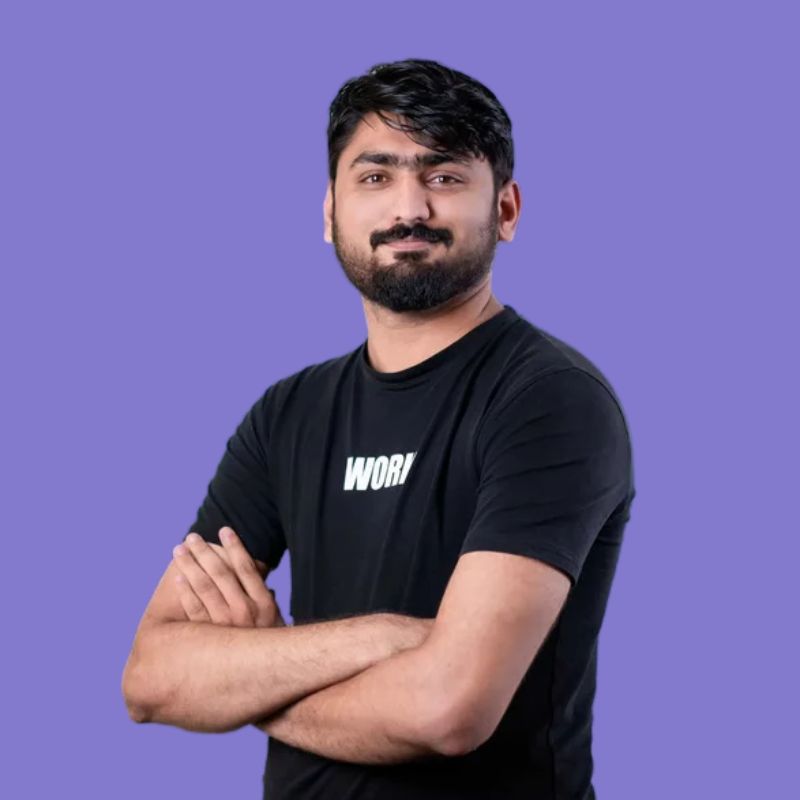
Tayyab Akmal
AI & QA Automation Engineer
6 years of catching critical bugs in fintech, e-commerce, and SaaS — then building the Playwright and Selenium automation that prevents them from shipping again.